|
|

"Carson FEELING GOOD once again"
|
Our Mission
|
|
To raise funds and provide support for the John M. Freeman Pediatric
Epilepsy Center at Johns Hopkins Hospital. This center provides care for
children of all ages with difficult-to-control epilepsy and offers
unique and exceptional treatments including surgery, diets, brain
stimulation, and medications in order to help and even cure
childhood-onset seizures. The Carson Harris Fund is directly involved in
supporting their clinical and research efforts to achieve these goals.
|
Carson's Story
|
In January of 2007, we took our 5-month old daughter, Carson, to Johns
Hopkins Hospital because she was having what appeared to be seizures.
Twelve hours, a spinal tap and an EEG scan of her brain later we were
told that she has a rare form of Epilepsy called "Infantile Spasms".
There are no words to describe the emotions we experienced upon hearing
the news that our daughter had about a 20% chance of recovering.
Fortunately for us, Johns Hopkins has one of the best pediatric epilepsy
programs in the country so we were immediately seen by specialists who
have hands on experience with this rare disorder. We were offered
multiple forms of treatment, including a regiment of steroids called
ACTH, Vigabatrin, Topamax and a more radical approach that Hopkins
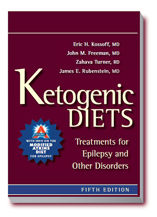
happens to specialize in called the ketogenic diet.
|
|
|
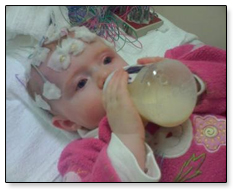
"Carson during an EEG Brain Scan"
|
The Ketogenic Diet
Normally, our bodies run on energy from glucose, which we get from food.
We can't store large amounts of glucose, however. We only have about a
24-hour supply. When a child has no food for 24 hours -- which is the
way the diet begins, usually in a hospital -- he or she uses up all the
stored glucose. With no more glucose to provide energy, the child's body
begins to burn stored fat. The ketogenic diet keeps this process going.
It forces the child's body to burn fat round the clock by keeping
calories low and making fat products the primary food that the child is
getting. In fact, the diet gets most (90 percent) of its calories from
fat. The rest comes from carbohydrates (2%) and protein (8%). The
amounts of food and liquid at each meal have to be carefully worked out
and weighed for each person. Doctors don't know precisely why a diet
that mimics starvation by burning fat for energy should prevent
seizures, although this is being studied. Nor do they know why the same
diet works for some children and not for others. (Source: The Epilepsy
Foundation Website)
Since Carson's Mom, Gerry, was perceptive enough to have caught the
subtle changes in her behavior in the first week, the doctors told us
that we not only had the option of trying the diet before the drugs, but
that it also had a better chance of working. If her condition had gone
untreated for a few more weeks (as many do) we would have had to move
straight into the medication but then we would have also had to simply
deal with the lasting side effects that the drugs can cause. Carson was
admitted to the hospital on a Saturday, she began fasting on Sunday and
had her last seizure on Tuesday night. Carson came home from the
hospital on Friday of that same week and continued the diet for 8
months. After her 1st month on the diet, the EEG scan of her brain had
almost completely normalized other than some slowing in the left
temporal lobe. After her 2nd month on the diet, her EEG was perfectly
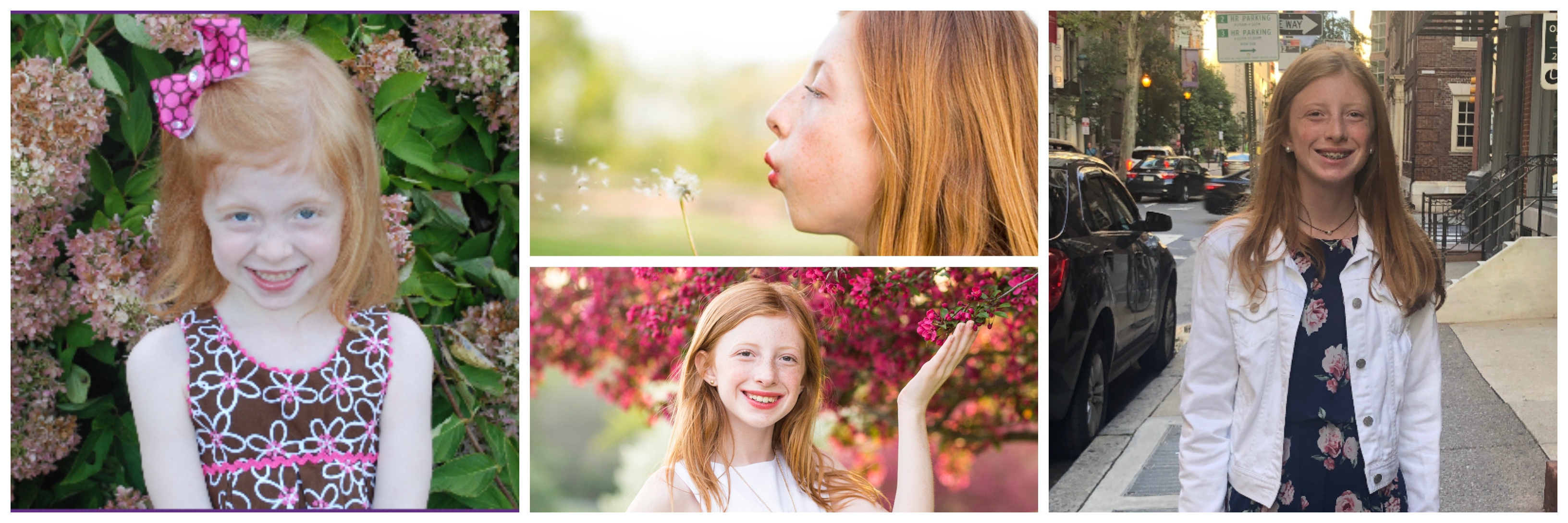
clear. We are overjoyed to report that Carson is now developing
normally and continues to be seizure free.
|